
India has become the third most innovative lower middle-income economy in the world.
Capital goods, IT, auto and pharmaceuticals lead gains for the financial year

For the seven months since February 2014, the benchmark index surged nearly 27%.
Any change in rates would mean more volatility; else, poll outcome-fuelled rally expected to continue.

More and more the buck will stop at the board. Look no further than Infosys, says Amit Tendon.
The Sensex ended below 28,000 for the second straight day at 27,869.

Could it have been more reformist? Of course, but this is an election year Budget, observes Akash Prakash.

Modi praised Tamil Nadu as a special place and lauded the Tamil language as eternal and its culture as global.

'To set up a successful business, one must have a solution to an existing problem or a better way of addressing the current solution.'

'The BJP's real weapons are Hindutva, organisation and finance.'
While a DFI will help banks derisk their loan portfolios, creation of a bad bank will clean up their balance sheets.

A total of Rs 52,759 crore has been raised by 61 companies through initial public offers till October this fiscal, higher than the funds mopped up through this route in the last financial year, the government told the Lok Sabha on Monday. Out of the 61 companies that hit the markets till October of the current fiscal, 34 entities were Small and Medium Enterprises (SMEs). Finance Minister Nirmala Sitharaman said that a large number of manufacturing and service sector companies are coming up for listing.
SBI, PNB, Bank of Baroda, Canara Bank, Dena Bank, Central Bank of India ended down 3%-12% each.

On the Sensex chart, IndusInd Bank was the top gainer, rallying over 11 per cent, followed by ICICI Bank, SBI, HDFC, M&M and Axis Bank. On the other hand, Dr Reddy's, Tech Mahindra and TCS were among the laggards.
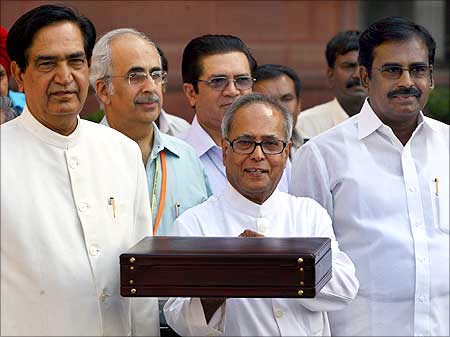
The sad truth is that the debt-to-GDP ratio will shoot up close to 90 per cent in the coming year, and the fiscal deficit glide path does not promise to reduce it substantially any time soon, predicts Mihir S Sharma.

Very gradual fiscal consolidation glide path with looser-than-expected fiscal policy; good quality spending mix and reasonable assumption on fiscal math; and focus on privatisation, asset monetisation and long-term funding for infrastructure investments, according to Morgan Stanley, are the three key themes from the Budget 2021.

An increase in government spending on the healthcare sector - from the current 1 per cent to 2.5-3 per cent of GDP - as envisaged in the National Health Policy 2017 could reduce out-of-pocket expenditures, as per the Economic Survey 2020-21. The rise in public spending can lead to a reduction in expenditures from 65 per cent to 30 per cent of overall healthcare spend, it noted. The Economic Survey said that for the country to effectively respond to future pandemics, the country's health infrastructure needs to be agile. Given its potential to provide healthcare access in remote areas, telemedicine needs to be harnessed to the fullest by especially investing in internet connectivity and health infrastructure, it added.

'India needs to adopt a more proactive policy of triggering exports to China.'
'This will have a multiplier effect in generating more jobs.'

After enduring volatility for the first two months of calendar year 2016 (CY16), global equity markets have recouped some of the losses in March. Jigar Shah, chief executive officer, Maybank Kim Eng Securities, believes the next triggers for the rally will come from a soft landing in China and no recession situation in the US.

India's real estate industry staged a rebound from 2020's downturn, with housing sales seen rising by over 50 per cent. The performance, though short of pre-COVID levels, has property developers hoping for stronger gains in the New Year and the beginning of a long upcycle. A strong foundation has been laid this year for revival in the Indian real estate sector, which is projected to reach $1 trillion mark by 2030 from $200 billion in the pre-pandemic year.
Economic activity has regained momentum from late-May after the dent caused by the second wave of COVID-19, and the pandemic's impact on the overall asset quality has been less than expected, Reserve Bank Governor Shaktikanta Das said on Thursday. However, Das flagged rising data breaches and cyber-attacks as among the risks for the recovering economy, along with others like firming global commodity prices. The governor also said the second wave had a "grievous toll" on the country.

In addition, 22,533 'Make in India' ventilators have been delivered to various states, Union territories and central institutions, the ministry said, adding that the Centre is also ensuring the installation and commissioning of the machines.

Dr Reddy's Laboratories on Friday soft-launched imported COVID-19 vaccine Sputnik V, with Deepak Sapra, a senior executive of the drug-maker, taking the first shot in Hyderabad.

Experts say the recent Rs 14,000-crore PNB fraud could have been avoided had there been an integration of PNB's CBS with its SWIFT system
Key relaxations traced in final regulations.

At $37 per dose, the Pfizer vaccine is much more expensive compared to $3 per dose for the Covishield.

The 30-share Sensex ended up 292 points at 29,571 and the 50-share Nifty closed up 75 points at 8,910.

'EV-charging is the next big opportunity after fuelling'
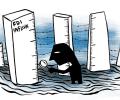
India remains an attractive destination for foreign direct investments (FDI) on account of healthy prospects of economic growth and its skilled workforce, according to a survey by Deloitte. A large proportion of international business leaders remain confident in India's short- and long-term prospects and are readying plans to make additional and first-time investments in the country, it said on Tuesday. "The survey, which questioned 1,200 business leaders of multinational corporations in the US, UK, Japan and Singapore, found that India remains an attractive destination for investments, scoring highly for its skilled workforce and prospects for economic growth," the survey - India's FDI Opportunity - said.

Employees across segments, including those involved in specialised jobs such as technology, compliance and risk management, have started leaving the bank fold in hordes, observes Tamal Bandyopadhyay.
SBI chief Rajnish Kumar said the focus going forward will be on cost reduction, rationalisation and reskilling of workforce, improving staff productivity and redeployment of workforce from admin offices to sales roles.
The infrastructure spending target for 2020-25 was revised because of additional and amended data provided by central ministries, state governments since the release of the summary NIP Report in December 2019 when it was pegged at Rs 100 trillion.
Gujarat, for the second consecutive year, has topped the Niti Aayog's Export Preparedness Index 2021 which is aimed at assessing the readiness of the states in terms of their export potential and performance. Gujarat was followed by Maharashtra, Karnataka, Tamil Nadu, Haryana, Uttar Pradesh, Madhya Pradesh, Punjab, Andhra Pradesh and Telengana, according to the government think tank's report. Union territories and states like Lakshadweep, Arunachal Pradesh, Mizoram, Ladakh and Meghalaya were placed at the bottom.
An alternative way is to make the Asba (Applications supported by blocked amount) facility compulsory for retail investors.

Sebi has asked intermediaries to stagger the offerings as much as possible, said people in the know and ensure adequate capacity building.
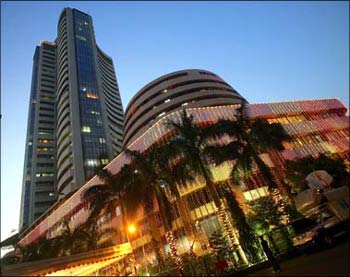
It will be difficult for the Indian equity to outperform overall growth to the extent bullish observers expect.

The latest circular from BSE that sought to cap the price movement of select scrips, especially the mid-, small-cap segments, traded on the exchange is not without a reason. A quick calendar year-to-date price check on the stocks from the categories put under 'Add-on Price Band Framework' by the BSE reveals a total of 210 stocks have seen their market price more than double. Among individual stocks, SC Agrotech, Adinath Textiles, Waaree Renewable Technologies, Steel Strips Infrastructure, Unistar Multimedia, Texel Industries, Raja Bahadur International and Hindustan Everest Tools from the BSE's X and XT group have rallied over 500 per cent during this period. Topping the charts is Gita Renewable Energy, which has zoomed 3,964 per cent to Rs 272.35 now from Rs 6.7 as on December 31, 2020.
The Asian markets are largely trading in the green, taking heart from a positive close on Wall Street.

June was a memorable month for the 101-year-old Tamilnad Mercantile Bank (TMB). Last month, the Thoothukudi-based bank witnessed two new landmarks in a history in which the last three decades could easily qualify for a Kollywood blockbuster.
 © 2026 Rediff.com - Advertise with us - Disclaimer - Privacy Policy - Sitemap - Feedback - About us - Terms of use - Grievances